Look out for the Darwin team, sharing their work at this year’s Ocean Sciences conference taking place February 16-21 in San Diego, California.
Look out for the Darwin team, sharing their work at this year’s Ocean Sciences conference taking place February 16-21 in San Diego, California.
Keisuke Inomura, Curtis Deutsch, Samuel T. Wilson, Takako Masuda, Evelyn Lawrenz, Bučinská Lenka, Roman Sobotka, Julia M. Gauglitz, Mak A. Saito, Ondřej Prášil, Michael J. Follows (2019), Quantifying Oxygen Management and Temperature and Light Dependencies of Nitrogen Fixation by Crocosphaera watsonii, mSphere, doi: 10.1128/mSphere.00531-19
Emily J. Zakem, Amala Mahadevan, Jonathan M. Lauderdale, and Michael J. Follows (2019), Stable aerobic and anaerobic coexistence in anoxic marine zones, The ISME Journal, doi: s41396-019-0523-8
Continue reading Stable aerobic and anaerobic coexistence in anoxic marine zones
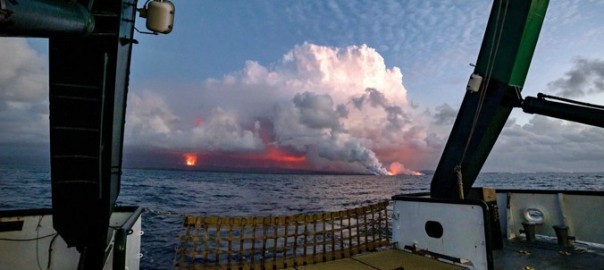
A new study led by Samuel T. Wilson from the University of Hawai’i, co-authored with Darwin Project researchers John Casey, Stephanie Dutkiewicz, Mick Follows, Christopher Hill, and Oliver Jahn, uses the Darwin ecosystem model embedded within an MITgcm (~2 km) resolution regional physical model of the North Pacific Ocean to study how the input of silicic acid, iron, nitrate, and phosphate along the southeast coast of Hawai‘i impacts nearby phytoplankton productivity. Continue reading Kīlauea Lava Fuels Phytoplankton Bloom off Hawaiʻi Island
David Talmy, Stephen J. Beckett, Darcy A.A. Taniguchi, Corina P.D. Brussard, Joshua S. Weitz, and Michael J. Follows (2019), An empirical model of carbon flow through marine viruses and microzooplankton grazers, Environmental Microbiology, doi: 10.1111/1462-2920.14626 Continue reading An empirical model of carbon flow through marine viruses and microzooplankton grazers
Ruifeng Zhang, Rachel L. Kelly, Kathryn M. Kauffman, Amber K. Reid, Jonathan M. Lauderdale, Michael J. Follows, Seth G. John (2019), Growth of marine Vibrio in oligotrophic environments is not stimulated by the addition of inorganic iron, Earth and Planetary Science Letters, doi: 10.1016/j.epsl.2019.04.002 Continue reading Growth of marine Vibrio in oligotrophic environments is not stimulated by the addition of inorganic iron
by Helen Hill for MIT CBIOMES
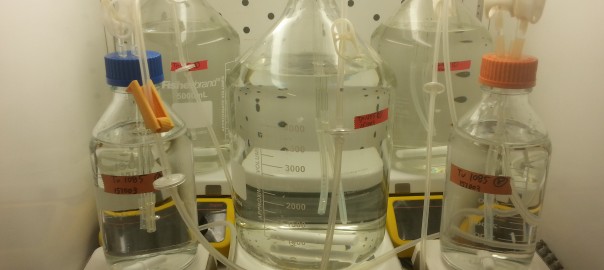
The Redfield ratio, the atomic ratio of carbon, nitrogen, and phosphorus (C:N:P) in phytoplankton and deep ocean waters, has often been treated as a constant 106:16:1. A new paper involving several CBIOMES co-authors, among them two from the MIT Darwin Group, presents compelling evidence for what causes this ratio to change within phytoplankton. Continue reading When Phytoplankton Go Hungry
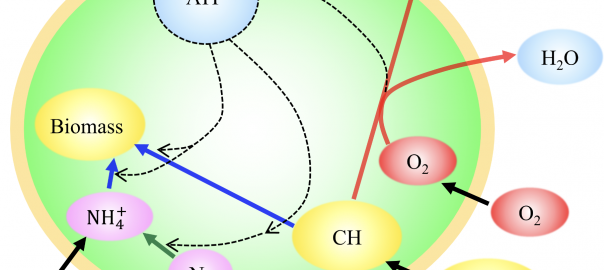
Former MIT Darwin Group member Keisuke Inomura, working with MIT CBIOMES investigator Mick Follows, presents a new quantitative model of nitrogen fixation in the presence of ammonium. Continue reading A Model for Nitrogen Fixation in the Presence of Ammonium
The Darwin Project’s Emily Zakem, Stephanie Dutkiewicz and Mick Follows show that physiological constraints and resource competition between phytoplankton and nitrifying microorganisms in the sunlit layer can yield this ocean trait. Continue reading Understanding Microbial Competition for Nitrogen
Look out for the Darwin team, sharing their work at this year’s Ocean Sciences conference taking place February 11-16 in Portland, Oregon. Continue reading Darwin Goes to Ocean Sciences 2018