David Talmy, Stephen J. Beckett, Darcy A.A. Taniguchi, Corina P.D. Brussard, Joshua S. Weitz, and Michael J. Follows (2019), An empirical model of carbon flow through marine viruses and microzooplankton grazers, Environmental Microbiology, doi: 10.1111/1462-2920.14626 Continue reading An empirical model of carbon flow through marine viruses and microzooplankton grazers
Tag Archives: Follows
Ruifeng Zhang, Rachel L. Kelly, Kathryn M. Kauffman, Amber K. Reid, Jonathan M. Lauderdale, Michael J. Follows, Seth G. John (2019), Growth of marine Vibrio in oligotrophic environments is not stimulated by the addition of inorganic iron, Earth and Planetary Science Letters, doi: 10.1016/j.epsl.2019.04.002 Continue reading Growth of marine Vibrio in oligotrophic environments is not stimulated by the addition of inorganic iron
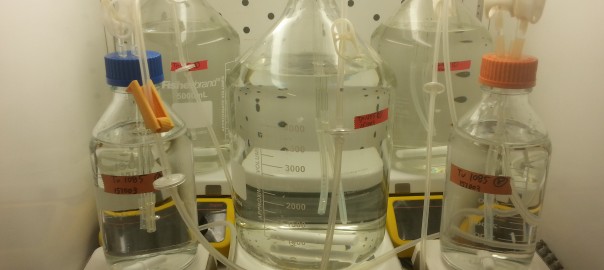
When Phytoplankton Go Hungry
by Helen Hill for MIT CBIOMES
The Redfield ratio, the atomic ratio of carbon, nitrogen, and phosphorus (C:N:P) in phytoplankton and deep ocean waters, has often been treated as a constant 106:16:1. A new paper involving several CBIOMES co-authors, among them two from the MIT Darwin Group, presents compelling evidence for what causes this ratio to change within phytoplankton. Continue reading When Phytoplankton Go Hungry
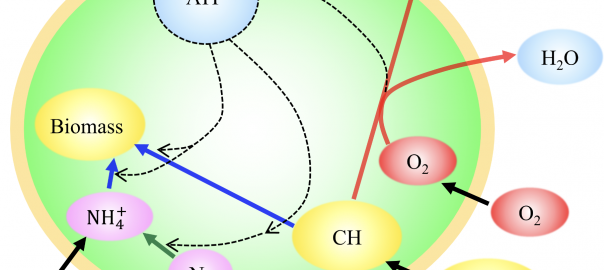
A Model for Nitrogen Fixation in the Presence of Ammonium
Former MIT Darwin Group member Keisuke Inomura, working with MIT CBIOMES investigator Mick Follows, presents a new quantitative model of nitrogen fixation in the presence of ammonium. Continue reading A Model for Nitrogen Fixation in the Presence of Ammonium
Understanding Microbial Competition for Nitrogen
The Darwin Project’s Emily Zakem, Stephanie Dutkiewicz and Mick Follows show that physiological constraints and resource competition between phytoplankton and nitrifying microorganisms in the sunlit layer can yield this ocean trait. Continue reading Understanding Microbial Competition for Nitrogen
Darwin Goes to Ocean Sciences 2018
Look out for the Darwin team, sharing their work at this year’s Ocean Sciences conference taking place February 11-16 in Portland, Oregon. Continue reading Darwin Goes to Ocean Sciences 2018
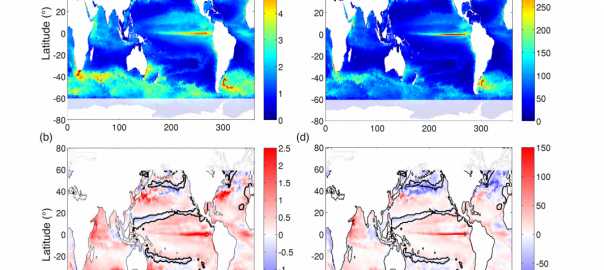
What you Can Do With a Really Rather Realistic Ocean Model
Helen Hill | Darwin Project
It’s been a decade since the inception of the MIT Darwin Project, an alliance between physical oceanographers, biogeochemists and marine microbiologists at the Massachusetts Institute of Technology (MIT). The goal of Darwin remains to couple state of the art physical models of global ocean circulation with biogeochemistry and genome-informed models of microbial processes to understand the interplay between different elements of the marine ecosystem leading to observed balances between physiology and the marine environment. Continue reading What you Can Do With a Really Rather Realistic Ocean Model
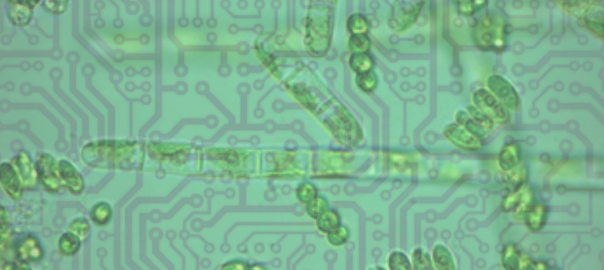
Phytoplankton & Chips
Helen Hill | Darwin Project
Microbes mediate the global marine cycles of elements, modulating atmospheric CO2 and helping to maintain the oxygen we all breath yet there is much about them scientists still don’t understand. Now, an award from the Simons Foundation will give researchers from the Darwin Project access to bigger, better computing resources to model these communities and probe how they work. Continue reading Phytoplankton & Chips
Rising Temperatures are Curbing Ocean’s Capacity to Store Carbon
Study from Follows Group finds large amounts of carbon dioxide, equivalent to yearly U.K. emissions, remain in surface waters. Continue reading Rising Temperatures are Curbing Ocean’s Capacity to Store Carbon
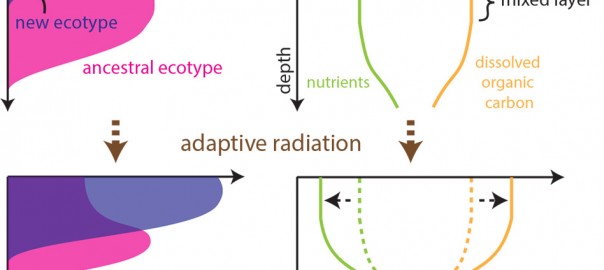
Tiny bacterium provides window into whole ecosystems
Ubiquitous marine organism has co-evolved with other microbes, promoting more complex ecosystems. Continue reading Tiny bacterium provides window into whole ecosystems