Leaving the cold of a New England February behind, the Darwin team will be in full attendance at this year’s Ocean Sciences conference taking place February 23-28 in Honolulu, Hawaii.

Leaving the cold of a New England February behind, the Darwin team will be in full attendance at this year’s Ocean Sciences conference taking place February 23-28 in Honolulu, Hawaii.

Darcy Taniguchi is a biological oceanographer, interested in the population dynamics of plankton, particularly phytoplankton and microzooplankton. While the majority of her research consists of theoretical modeling studies examining the size-based interactions of plankton, she likes to complement that with laboratory and field work whenever she has the opportunity.

Idealized equilibrium models have attributed the observed size structure of marine communities to the interactions between nutrient and grazing control. In a new paper in the Journal of Plankton Research Ben Ward and co-authors Stephanie Dutkiewicz and Mick Follows examine this theory in a more realistic context using a size-structured global ocean food-web model, together with a much simplified version of the same model for which equilibrium solutions are readily obtained.
Continue reading Size Structure: exploring nutrient versus grazing control
Ward, B.A., S. Dutkiewicz, and M.J. Follows (2014) Modelling spatial and temporal patterns in size-structured marine plankton communities: top-down and bottom-up controls, Journal of Plankton Research, 0, 1-17, doi:10.1093/plankt/fbt097

For some microbes, the motto for growth is not so much “every cell for itself,” but rather, “all for one and one for all.”
MIT researchers have found that cells in a bacterial colony grow in a way that benefits the community as a whole. That is, while an individual cell may divide in the presence of plentiful resources to benefit itself, when a cell is a member of a larger colony, it may choose instead to grow in a more cooperative fashion, increasing an entire colony’s chance of survival.
Kempes, CP et al. (2013) Morphological optimization for access to dual oxidants in biofilms PNAS, 111, 1, 208-213, doi:10.1073/pnas.1315521110)
Winners and Losers: Phytoplankton in a Changing Climate
Stephanie Dutkiewicz at MIT Future Ocean Symposium, September 9, 2013.
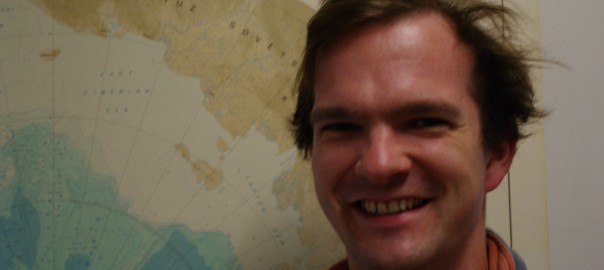
Jonathan Lauderdale is a physical oceanographer and ocean biogeochemical modeller “intrigued” by the mechanisms through which the ocean can alter Earth’s climate and atmospheric CO2 concentration both in the past and under future anthropogenic changes. So far his focus has been on high latitude regions, particularly the Southern Ocean. He mostly uses global coarse resolution numerical models of ocean circulation coupled to simplified biogeochemistry routines, but also exploits composite tracers to reveal how different components of carbon and nutrient cycles operate.
Clayton, S., S. Dutkiewicz , O. Jahn, and M.J. Follows (2013), Ocean eddies and dispersal maintain phytoplankton diversity, Limnology and Oceanography, Fluids and Environments, Volume 3: 182–197, doi: 10.1215/21573689-2373515
Ward, B.A., S. Dutkiewicz, and M.J. Follows (2013), Top-down and bottom-up controls in a global size-structured plankton food-web model, Journal of Plankton Research , 0, 1-17, doi: 10.1093/plankt/fbt097