Moore, R.M., M. Kienast, M. Fraser, J. Cullen, C. Deutsch, S. Dutkiewicz, M.J. Follows, and C.J. Somes (2014), Substantial underestimation of nitrogen fixation suggested by hydrogen supersaturations in the Atlantic, Journal of Geophysical Research - Oceans , 119, 4340-4350, doi: 10.1002/2014JC010017.
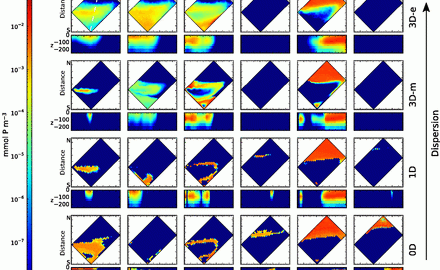
Mixing Down Diversity
Phytoplankton are an extremely diverse set of floating, microscopic organisms, which are freely transported by water movements (current, eddies, etc.) and make up the base of the oceanic food web. This work, published in the September issue of Limnology & Oceanography: Fluids & Environments, explores how their diversity is affected by dispersal by different scales of motions in the ocean. Continue reading Mixing Down Diversity
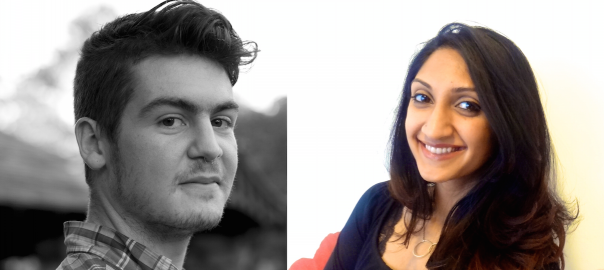
Darwin Welcomes Two New Students
The Darwin Project is thrilled to add two stellar new MIT-WHOI Joint Program graduate students to its ranks this fall. Continue reading Darwin Welcomes Two New Students
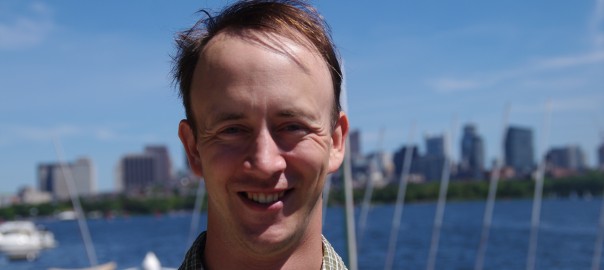
New Postdoc Chris Follett
Chris Follett is an oceanographer interested in the interactions between the ocean’s biological and chemical systems. His educational background is in physics (BS, MIT), and chemical oceanography (PhD, MIT-WHOI). He joins the Darwin Project team to focus on the symbiotic relationships between nitrogen fixing cyanobacteria and diatoms. Continue reading New Postdoc Chris Follett
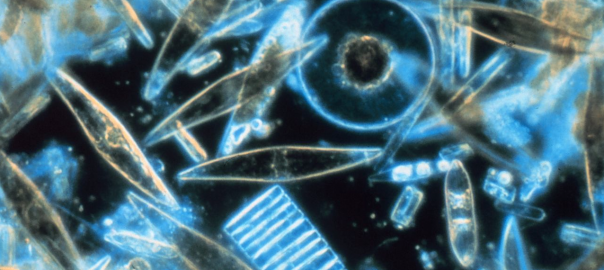
Broadening the ‘SCOPE’ of microbial oceanography
With an infusion of funds from the Simons Foundation, a collaboration Darwin Project lead Mick Follows and other MIT researchers and colleagues will break new ground in the study of marine microbes. Continue reading Broadening the ‘SCOPE’ of microbial oceanography
Levy, M., O. Jahn, S. Dutkiewicz, and M.J. Follows (2014), Phytoplankton diversity and community structure affected by oceanic disperal and mesoscale turbulence, Limnology and Oceanography: Fluids and Environment, 4, 67-84, doi: 10.1215/21573689-2768549.
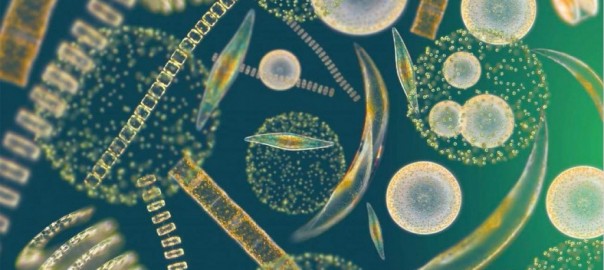
Phytoplankton Diversity versus Productivity in the Ocean
by Sergio Vallina
Dept of Marine Biology and Oceanography, Institute of Marine Sciences, Barcelona
How does species richness vary with ecosystem productivity for marine phytoplankton? This question has fascinated biological oceanographers for decades. Phytoplankton communities are composed of many species of unicellular micro-algae. They are at the base of the marine trophic foodweb, growing and surviving by means of photosythesis by fixing CO2; a process known as primary production. Continue reading Phytoplankton Diversity versus Productivity in the Ocean
Publication
Vallina, S.M., M.J. Follows, S. Dutkiewicz, J. Montoya, P. Cermeno, and M. Loreau (2014),
Global relationship between phytoplankton diversity and productivity in the ocean, Nature Communications, 5, 4299, doi: 10.1038/ncomms5299
Publication
Prowe, A.E.F., M. Pahlow, S. Dutkiewicz, and A. Oschlies (2014), How important is diversity to capture environmental change responses in ecosystem models? Biogeosciences, 11, 3397–3407, 2014, doi: 10.5194/bg-11-3397-2014
Publication:
Barton, A.D., B.A. Ward, R.G. Williams, and M.J. Follows (2014), The impact of fine-scale turbulence on phytoplankton community structure. Limnology and Oceanography: Fluids and Environments, 4, 34-49, doi: 10.1215/21573689-2651533