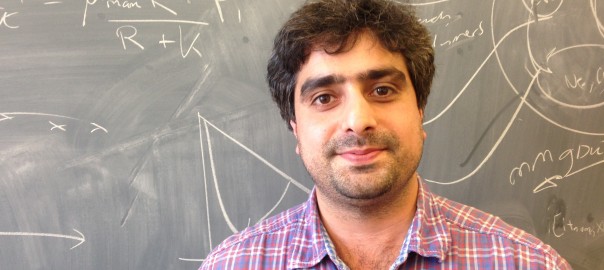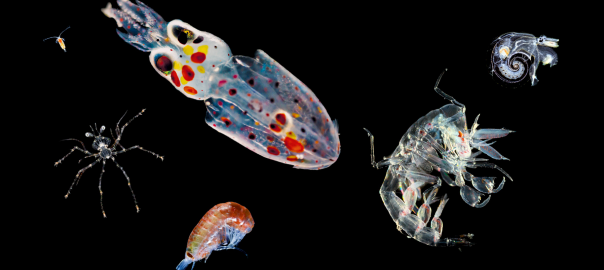
Using tiny marine microbes to model climate change: MIT News profiles Darwin’s Mick Follows Continue reading An Ocean of Opportunity
New Darwin project postdoc Mohammad Ashkezari got his PhD in atomic physics, at Simon Fraser University (Canada) in collaboration with the ALPHA experiment at CERN, Geneva Switzerland. Continue reading New Postdoc Mohammad Ashkezari
Alexandra Z. Worden, Michael J. Follows, Stephen J. Giovannoni, Susanne Wilken, Amy E. Zimmerman, and Patrick J. Keeling (2015) Rethinking the marine carbon cycle: Factoring in the multifarious lifestyles of microbes. Science 13 February 2015: Vol. 347 no. 6223, doi: 10.1126/science.1257594
Darwin researchers Stephanie Dutkiewicz, Jonathen Lauderdale, David Talmy, and Darcy Taniguchi are off to Granada, Spain this month to attend the the Association of the Sciences of Limnology, and Oceanography (ASLO) 2015 annual meeting taking place from 22-27 February. Continue reading 2015 Aquatic Sciences Meeting
Talmy, D., J. Blackford, N. J. Hardman-Mountford, L. Polimene, M.J. Follows, and R.J. Geider (2014) Flexible C : N ratio enhances metabolism of large phytoplankton when resource supply is intermittent. Biogeosciences, 11, 4881-4895, doi: 10.5194/bg-11-4881-2014
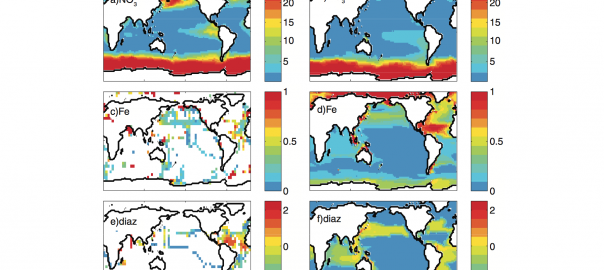
In their new competition theory paper, appearing in the 2014 issue of Biogeosciences, Dutkiewicz et al examine the sensitivity of the biogeography of nitrogen fixers to a warming climate and increased aeolian iron deposition in the context of a global earth system model. Continue reading Life on the Edge – How shifting marine province boundaries could provide a new metric for global change
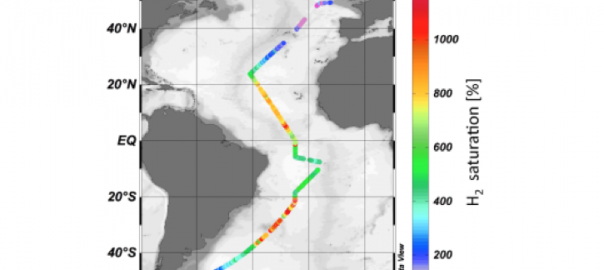
The nitrogen cycle is fundamental to Earth’s biogeochemistry. Yet major quantitative uncertainties remain, particularly regarding the global oceanic nitrogen fixation rate. Continue reading Mapping Nitrogen Fixation? Follow the Hydrogen.
Dutkiewicz, S., Ward, B. A., Scott, J. R., and Follows, M. J. (2014) Understanding predicted shifts in diazotroph biogeography using resource competition theory, Biogeosciences, 11, 5445-5461, doi: 10.5194/bg-11-5445-2014.
Moore, R.M., M. Kienast, M. Fraser, J. Cullen, C. Deutsch, S. Dutkiewicz, M.J. Follows, and C.J. Somes (2014), Substantial underestimation of nitrogen fixation suggested by hydrogen supersaturations in the Atlantic, Journal of Geophysical Research - Oceans , 119, 4340-4350, doi: 10.1002/2014JC010017.
Phytoplankton are an extremely diverse set of floating, microscopic organisms, which are freely transported by water movements (current, eddies, etc.) and make up the base of the oceanic food web. This work, published in the September issue of Limnology & Oceanography: Fluids & Environments, explores how their diversity is affected by dispersal by different scales of motions in the ocean. Continue reading Mixing Down Diversity