Publication
Ward, B.A., S. Dutkiewicz, and M.J. Follows (2013), Top-down and bottom-up controls in a global size-structured plankton food-web model, Journal of Plankton Research , 0, 1-17, doi: 10.1093/plankt/fbt097
Ward, B.A., S. Dutkiewicz, and M.J. Follows (2013), Top-down and bottom-up controls in a global size-structured plankton food-web model, Journal of Plankton Research , 0, 1-17, doi: 10.1093/plankt/fbt097
Lauderdale, J.M., A.C.N. Garabato, K.I.C. Oliver, M.J. Follows and R.G. Williams(2013), Wind-driven changes in Southern Ocean residual circulation, ocean carbon reservoirs and atmospheric CO2, Climate Dynamics, vol. 41, pp. 2145, doi: 10.1007%2Fs00382-012-1650-3
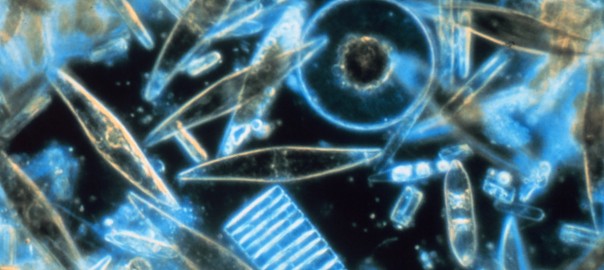
Predators’ switching towards the most abundant prey is a mechanism that stabilizes population dynamics and helps overcome competitive exclusion of species in food webs. However, current formulations of active prey-switching in marine ecosystem models display non-maximal feeding; the total ingestion of prey by predators decays exponentially with the number of prey species even though the total prey biomass stays constant.
Continue reading The dynamics of dining in an all-you-can-eat-phytoplankton buffet
Vallina, S. M. , B. A. Ward, S. Dutkiewicz, and M. J. Follows (2013), Maximal feeding with active prey-switching: a kill-the-winner functional response and its effect on global diversity and biogeography, Progress in Oceanography, 120, 93–109, doi: 10.1016/j.pocean.2013.08.001
Goebel, N.L., C.A. Edwards, J.P. Zehr, M.J. Follows and S.G. Morgan (2013), Modeled phytoplankton diversity and productivity in the California Current System, Ecological Modelling, vol. 264, pp. 37, doi: 10.1016/j.ecolmodel.2012.11.008
Ice-core measurements reveal a highly asymmetric cycle in Antarctic temperature and atmospheric CO2 over the last 800,000 years. Both CO2 and temperature decrease over 100,000 years going into a glacial period, then rise steeply over less than 10,000 years at the end of a glacial. There does not yet exist wide agreement about the causes of this cycle or about the origin of its shape. In this article, recently accepted in the journal Global Biogeochemical Cycles, Darwin researchers Anne Willem Omta, Mick Follows and co-authors, explore the possibility that an ecologically driven oscillator may play a role in the dynamics.
Continue reading On the potential role of marine calcifiers in glacial-interglacial dynamics
Ward, B.A., M. Schartau, A. Oschlies, A.P. Martin, M.J. Follows and T.R. Anderson, TR (2013), When is a biogeochemical model too complex? Objective model reduction and selection for North Atlantic time-series sites Progress in Oceanography, vol. 116, pp. 49, doi:10.1016/j.pocean.2013.06.002
Ward, B.A., S. Dutkiewicz, C.M. Moore and M.J. Follows (2013), Iron, phosphorus, and nitrogen supply ratios define the biogeography of nitrogen fixation Limnology and Oceanography, vol. 58, pp. 2059, doi: 10.4319/lo.2013.58.6.2059
Dutkiewicz, S., J.R. Scott and M.J. Follows (2013), Winners and losers: Ecological and biogeochemical changes in a warming ocean, Global Biogeochemical Cycles, vol. 27, pp. 463, doi: 10.1002/gbc.20042
Fiksen, O., M.J. Follows and D.L. Aksnes (2013), Trait-based models of nutrient uptake in microbes extend the Michaelis-Menten framework, Limnology and Oceanography, vol. 58, pp. 193, doi: 10.4319/lo.2013.58.1.0193