Publication:
Clayton, S., T. Nagai and M.J. Follows (2014), Fine scale phytoplankton community structure across the Kuroshio Front. J. Plankton Res., 1-14, doi: 10.1093/plankt/fbu020
Clayton, S., T. Nagai and M.J. Follows (2014), Fine scale phytoplankton community structure across the Kuroshio Front. J. Plankton Res., 1-14, doi: 10.1093/plankt/fbu020

Leaving the cold of a New England February behind, the Darwin team will be in full attendance at this year’s Ocean Sciences conference taking place February 23-28 in Honolulu, Hawaii.

Idealized equilibrium models have attributed the observed size structure of marine communities to the interactions between nutrient and grazing control. In a new paper in the Journal of Plankton Research Ben Ward and co-authors Stephanie Dutkiewicz and Mick Follows examine this theory in a more realistic context using a size-structured global ocean food-web model, together with a much simplified version of the same model for which equilibrium solutions are readily obtained.
Continue reading Size Structure: exploring nutrient versus grazing control
Ward, B.A., S. Dutkiewicz, and M.J. Follows (2014) Modelling spatial and temporal patterns in size-structured marine plankton communities: top-down and bottom-up controls, Journal of Plankton Research, 0, 1-17, doi:10.1093/plankt/fbt097
Winners and Losers: Phytoplankton in a Changing Climate
Stephanie Dutkiewicz at MIT Future Ocean Symposium, September 9, 2013.
Clayton, S., S. Dutkiewicz , O. Jahn, and M.J. Follows (2013), Ocean eddies and dispersal maintain phytoplankton diversity, Limnology and Oceanography, Fluids and Environments, Volume 3: 182–197, doi: 10.1215/21573689-2373515
Ward, B.A., S. Dutkiewicz, and M.J. Follows (2013), Top-down and bottom-up controls in a global size-structured plankton food-web model, Journal of Plankton Research , 0, 1-17, doi: 10.1093/plankt/fbt097
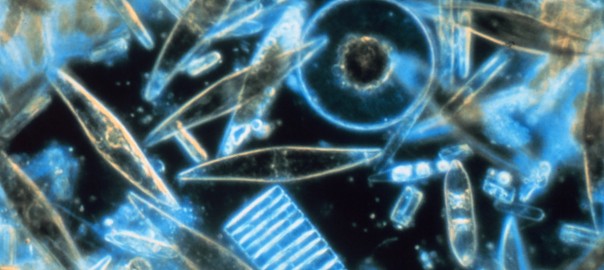
Predators’ switching towards the most abundant prey is a mechanism that stabilizes population dynamics and helps overcome competitive exclusion of species in food webs. However, current formulations of active prey-switching in marine ecosystem models display non-maximal feeding; the total ingestion of prey by predators decays exponentially with the number of prey species even though the total prey biomass stays constant.
Continue reading The dynamics of dining in an all-you-can-eat-phytoplankton buffet
Vallina, S. M. , B. A. Ward, S. Dutkiewicz, and M. J. Follows (2013), Maximal feeding with active prey-switching: a kill-the-winner functional response and its effect on global diversity and biogeography, Progress in Oceanography, 120, 93–109, doi: 10.1016/j.pocean.2013.08.001
Goebel, N.L., C.A. Edwards, J.P. Zehr, M.J. Follows and S.G. Morgan (2013), Modeled phytoplankton diversity and productivity in the California Current System, Ecological Modelling, vol. 264, pp. 37, doi: 10.1016/j.ecolmodel.2012.11.008