Study led by principal research scientist Stephanie Dutkiewicz finds many species may die out and others may migrate significantly as ocean acidification intensifies. Continue reading Ocean acidification may cause dramatic changes to phytoplankton
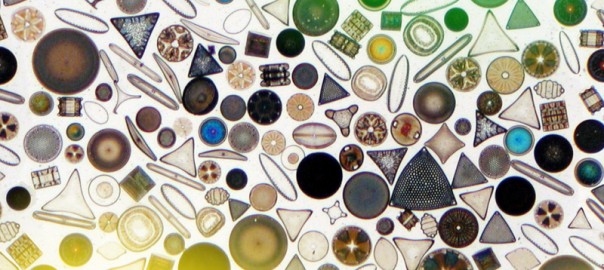
Study led by principal research scientist Stephanie Dutkiewicz finds many species may die out and others may migrate significantly as ocean acidification intensifies. Continue reading Ocean acidification may cause dramatic changes to phytoplankton
Dutkiewicz, S., J.J. Morris, M.J. Follows, J. Scott, O. Levitan, S.T. Dyhrman, and I. Berman-Frank, 2015, Impact of Ocean Acidification on the Structure of Future Phytoplankton Communities. Nature Climate Change, doi: 10.1038/nclimate2722
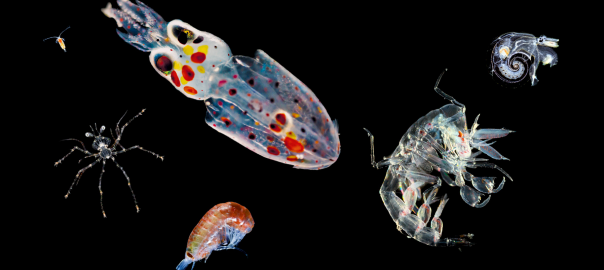
Read this story at oceans.mit.edu
Tara Oceans, an international consortium of researchers that explored the world’s oceans in hopes of learning more about one of its smallest inhabitants, reported their initial findings this week in a special issue of Science. Plankton are vital to life on Earth—they absorb carbon dioxide, generate nearly half of the oxygen we breathe, break down waste, and are a cornerstone of the marine food chain. Now, new research indicates the diminutive creatures are not only more diverse than previously thought, but also profoundly affected by their environment. Continue reading Uncovering a Diverse Invisible Ocean World
Villar, E., Farrant, G.K., Follows, M.J., et al, 2015, Environmental characteristics of Agulhas rings affect interocean plankton transport. Science, Vol. 348 no. 6237, doi: 10.1126/science.1261447
Alexandra Z. Worden, Michael J. Follows, Stephen J. Giovannoni, Susanne Wilken, Amy E. Zimmerman, and Patrick J. Keeling (2015) Rethinking the marine carbon cycle: Factoring in the multifarious lifestyles of microbes. Science 13 February 2015: Vol. 347 no. 6223, doi: 10.1126/science.1257594
Darwin researchers Stephanie Dutkiewicz, Jonathen Lauderdale, David Talmy, and Darcy Taniguchi are off to Granada, Spain this month to attend the the Association of the Sciences of Limnology, and Oceanography (ASLO) 2015 annual meeting taking place from 22-27 February. Continue reading 2015 Aquatic Sciences Meeting
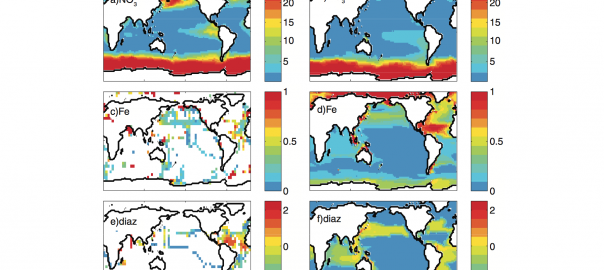
In their new competition theory paper, appearing in the 2014 issue of Biogeosciences, Dutkiewicz et al examine the sensitivity of the biogeography of nitrogen fixers to a warming climate and increased aeolian iron deposition in the context of a global earth system model. Continue reading Life on the Edge – How shifting marine province boundaries could provide a new metric for global change
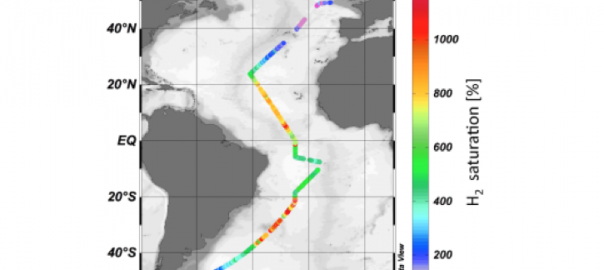
The nitrogen cycle is fundamental to Earth’s biogeochemistry. Yet major quantitative uncertainties remain, particularly regarding the global oceanic nitrogen fixation rate. Continue reading Mapping Nitrogen Fixation? Follow the Hydrogen.
Dutkiewicz, S., Ward, B. A., Scott, J. R., and Follows, M. J. (2014) Understanding predicted shifts in diazotroph biogeography using resource competition theory, Biogeosciences, 11, 5445-5461, doi: 10.5194/bg-11-5445-2014.
Moore, R.M., M. Kienast, M. Fraser, J. Cullen, C. Deutsch, S. Dutkiewicz, M.J. Follows, and C.J. Somes (2014), Substantial underestimation of nitrogen fixation suggested by hydrogen supersaturations in the Atlantic, Journal of Geophysical Research - Oceans , 119, 4340-4350, doi: 10.1002/2014JC010017.