Publication
Bragg, J., S. Dutkiewicz, O. Jahn, M. Follows, S.W. Chisholm (2010), Modeling selective pressures on picocyanobacterial nitrogen use in the global ocean, PLoS ONE, 5, e9569. doi:10.1371/journal.pone.0009569. LINK
Bragg, J., S. Dutkiewicz, O. Jahn, M. Follows, S.W. Chisholm (2010), Modeling selective pressures on picocyanobacterial nitrogen use in the global ocean, PLoS ONE, 5, e9569. doi:10.1371/journal.pone.0009569. LINK
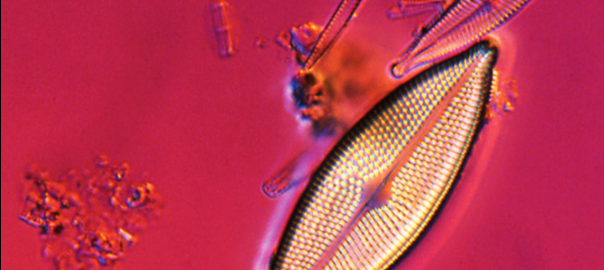
“Phytoplankton diversity depends on balance between competition and the ocean’s physical dynamics, new research suggests”
By Morgan Bettex, MIT News Office
Read this story at MIT News
Phytoplankton are single-celled organisms that serve as the base of the marine food web and provide half the oxygen we breathe on Earth. They also play a key role in global climate change by removing carbon from the atmosphere and injecting it deep into the oceans.
Scientists study phytoplankton to understand how the tiny plants help transport elements like carbon through the environment. Although they understand much of what phytoplankton do, less is understood about why particular plankton live in particular environments and what maintains the diversity of phytoplankton.
Barton, A.D., S. Dutkiewicz, G. Flierl, J. Bragg, and M.J. Follows (2010), Patterns of Diversity in Marine Phytoplankton, Science, 327, 1509 – 1511, doi: 10.1126/science.1184961
Dutkiewicz, S., M.J. Follows and J. Bragg (2009), Modeling the coupling of ocean ecology and biogeochemistry, Global Biogeochemical Cycles, 23, GB4017, doi:10.1029/2008GB003405
Verdy, A., M. Follows and G. Flierl (2009), Evolution of phytoplankton cell size in an allometric model, Marine Ecology Progress Series, 379, 1-12, doi: 10.3354/meps07909
Monteiro, F. and M. Follows (2009), On the interannual variability of nitrogen fixation in the subtropical gyres, Journal of Marine Research, 67, 1-20, doi: 10.1357/002224009788597944
Cermeno, P., S. Dutkiewicz, P.G. Falkowski, M. Follows, R.P. Harris, and O. Schofield (2008), The role of oceanic nutricline depth in regulating Earth’s carbon cycle, Proceedings of the National Academy of Sciences, 105, doi:10.1073/pnas.0811302106
Hood, R.A., E.A. Laws, M.J. Follows and D.A. Siegel (2007), Modeling and prediction of microbial populations in the genomic era, Oceanography, 20, 155-165, doi: 10.5670/oceanog.2007.61
Follows, M.J., S. Dutkiewicz, S. Grant and S.W. Chisholm (2007), Emergent biogeography of microbial communities in a model ocean, Science, 315, 1843-1846, doi: 10.1126/science.1138544
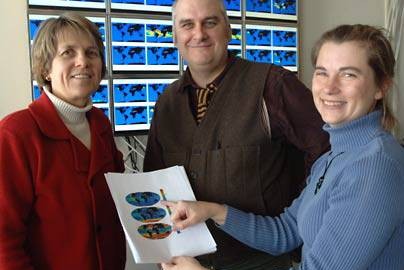
“Simulation condenses 10 years’ evolution into five days of computing”
Denise Brehm, Civil and Environmental Engineering
Read this story at MIT News
Scientists at MIT have created an ocean model so realistic that the virtual forests of diverse microscopic plants they “sowed” have grown in population patterns that precisely mimic their real-world counterparts.
This model of the ocean is the first to reflect the vast diversity of the invisible forests living in our oceans–tiny, single-celled green plants that dominate the ocean and produce half the oxygen we breathe on Earth. And it does so in a way that is consistent with the way real-world ecosystems evolve according to the principles of natural selection. Continue reading Ocean Model Captures Diversity of Underwater Forests